
What Changes, What Doesn’t, and When It Matters
If you’re self-employed (or thinking about it), you’ve probably heard all three of these terms:
They’re often used interchangeably in conversation — but they are not the same thing.
Let’s start simple.


The Short Version (Skimmable Summary)
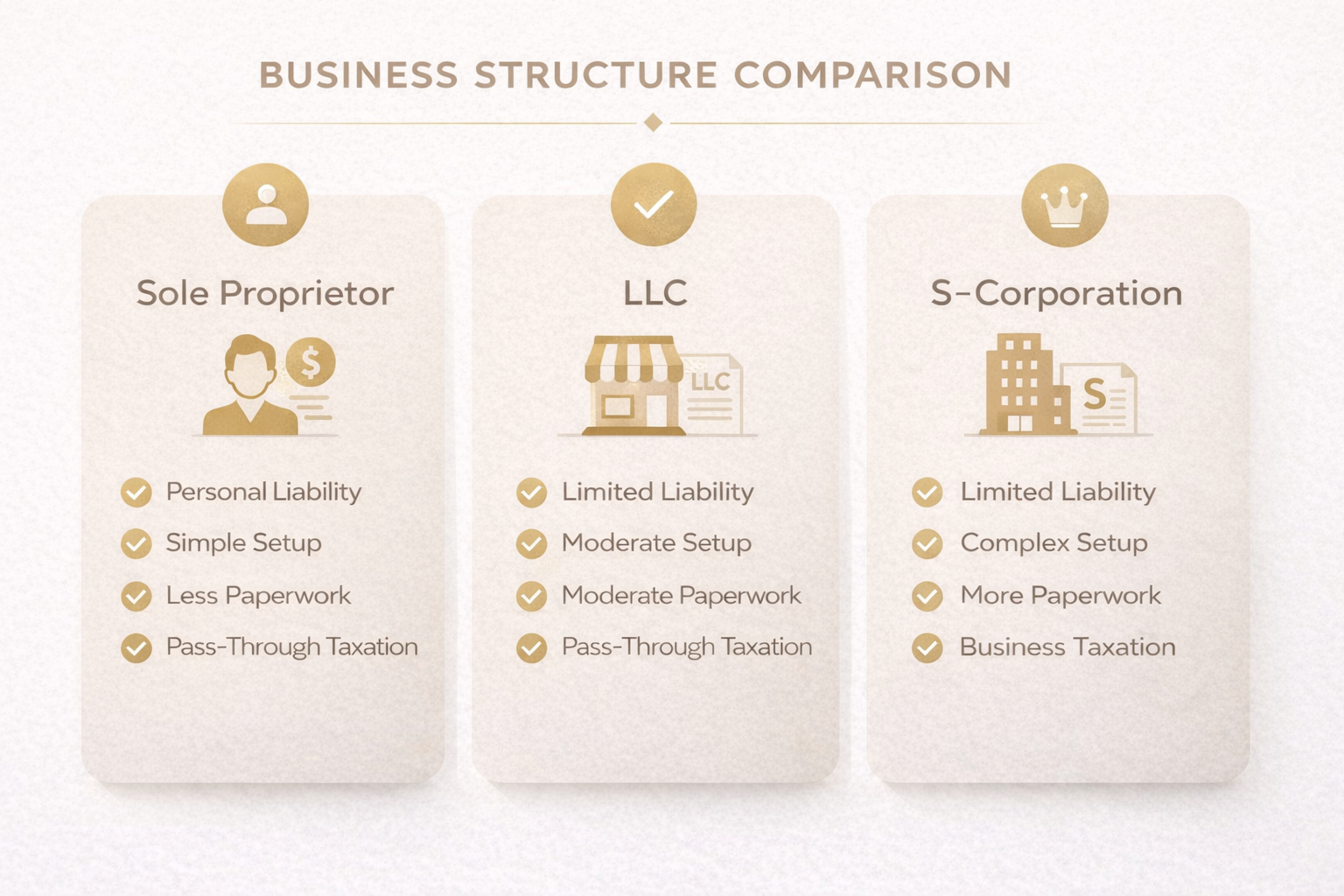
Sole Proprietor = You and your business are legally the same.
Single-Member LLC = Legal protection added, but taxes are the same as a sole prop (by default).
S-Corp (for an LLC) = A tax election that may reduce self-employment tax if profits are high enough to justify the added complexity.
Now let’s break each one down.
1️⃣ Sole Proprietor (Default Self-Employed Status)
If you:
- Start invoicing clients
- Don’t form a legal entity
- Don’t file special paperwork with your state
You are automatically a sole proprietor.
How Taxes Work
- File Schedule C with your personal 1040
- Pay:
- Income tax
- Self-employment tax (15.3%)
Self-employment tax covers:
- Social Security (12.4%)
- Medicare (2.9%)
Your net profit is subject to both income tax and self-employment tax.
There is no separate business return.
Pros
- Simple
- Inexpensive
- No extra filings
Cons
- No liability protection
- Full profit subject to self-employment tax
2️⃣ Single-Member LLC (Default Tax Treatment)
An LLC (Limited Liability Company) is created at the state level.
Important:
👉 An LLC is a legal structure, not a tax structure.
If you form an LLC but do not elect S-Corp status, the IRS treats you as a:
“Disregarded entity.”
That means:
- You still file Schedule C
- You still pay self-employment tax
- Taxes work exactly like a sole proprietor
The only major difference?
Legal liability protection.
Pros
- Legal separation between you and the business
- More professional structure
- Same simple tax filing as sole prop
Cons
- Still pay self-employment tax on all net profit
- State filing fees and compliance requirements
3️⃣ How to Elect S-Corp Status for an LLC
This is where taxes actually change.
An LLC can choose to be taxed as an S-Corporation by filing Form 2553 with the IRS.
Now:
- The business files its own tax return (Form 1120-S)
- You must run payroll
- You must pay yourself a “reasonable salary”
Here’s the key:
You pay payroll taxes (Social Security & Medicare) on your salary —
but not on the remaining profit distributions.
That’s where potential tax savings happen.
Simple Example
Let’s say your business earns:
Net Profit = $80,000
As Sole Prop or Default LLC:
All $80,000 is subject to self-employment tax.
As S-Corp:
You pay yourself:
- $50,000 salary (payroll taxes apply)
- $30,000 distribution (no self-employment tax)
You may save several thousand dollars in self-employment tax —
but you now have:
- Payroll costs
- Corporate tax filing fees
- More bookkeeping requirements
When Does S-Corp Make Sense?
There’s no magic IRS number — but in practice:
Many professionals start considering S-Corp status when:
✔ Profits are consistently above $40,000–$60,000 per year
✔ Income is stable (not wildly fluctuating)
✔ You’re comfortable with added compliance
✔ The tax savings exceed the admin costs
If net profit is under ~$40,000, the complexity often outweighs the benefit.
How to Report Side Hustle Income & a W-2 Job
If you have:
- A W-2 job
- And a side business
Your business profit still:
- Flows onto your 1040
- Stacks on top of your W-2 income for income tax purposes
- Is subject to self-employment tax (unless S-Corp elected)
Social Security has an annual cap — so high W-2 wages can affect how much additional Social Security tax you owe on the business side.
The Biggest Misunderstanding
Forming an LLC does not automatically reduce taxes.
The tax change only happens if:
- An S-Corp election is filed
- Payroll is properly run
- Reasonable compensation rules are followed
LLC = legal protection
S-Corp = potential tax strategy
They are not the same thing.
If you’re just starting out:
- Sole prop or default LLC is usually sufficient.
If profits are growing:
- It may be time to evaluate S-Corp status.
The best structure depends on:
- Profit level
- Risk exposure
- Administrative tolerance
- Long-term growth plans
And most importantly — this isn’t a one-time decision.
You can evolve your structure as your business grows.
FAQs
What is a single member LLC?
A single member LLC is the same as a Sole Proprietorship. It’s when just one person owns the company that has the LLC.
Does a single member LLC need an EIN?
An EIN is like a social security number, but for a business. It’s through the IRS and it is required for all businesses regardless of legal or protected status.
What is a sole proprietor?
That just means that there is one person who owns the company.
Can a sole proprietor have employees?
Yes, the sole proprietor is the one who owns the company, no partner, and they can have employees.
Does a sole proprietor need an EIN?
Yes, an EIN is required for all businesses and is obtained through the IRS. An EIN has nothing to do with the protection offered by an LLC.
Which business structure offers liability protection?
All types of LLC offer some liability protection. You should always consult with a legal representative or insurance broker to see if your business needs additional liability protection via insurance.
Can I switch from a sole proprietorship to an LLC or S-Corp?
Yes, you can switch from a sole proprietorship to an LLC and with the LLC you can specify S-Corp if that suits your business.
Which structure has the lowest taxes?
LLC structure does not affect taxes in and of itself. If you select the S-Corp status as an LLC, this CAN help reduce your self-employment tax, but this is only suggested when your profits are high enough to make up for the added accounting complexity and cost.
Do I need a lawyer or accountant to set one up?
No, an LLC can be set up by the owner online or with the help of a company or person such as myself.
more2heather@gmail.com | (206) 227-6128