

One of the most common questions new business owners ask is:
“What’s the best way to pay myself from my LLC?”
It sounds like it should have a simple answer.
But the real answer is:
It depends on how your LLC is taxed.
That is where many business owners get confused. An LLC is a legal structure. But for tax purposes, an LLC can be treated in a few different ways.
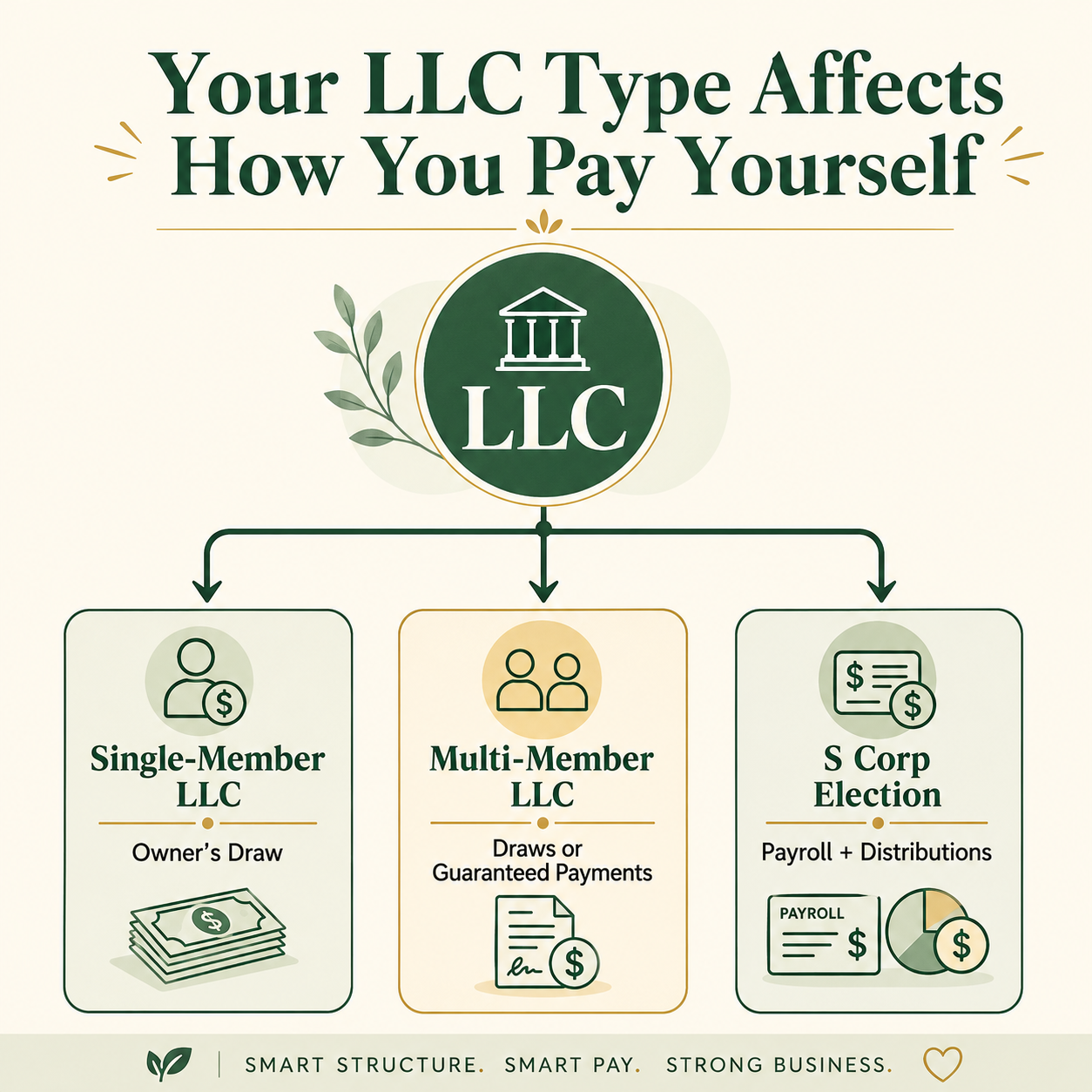
Your LLC might be taxed as:
- A single-member LLC
- A multi-member LLC
- An S corporation
- A corporation
Each setup can affect how you pay yourself.
So before you decide whether to take a draw, run payroll, or take distributions, start with this question:
How is my LLC taxed?
Let’s walk through the most common options.
First: An LLC Does Not Automatically Mean Payroll
A lot of business owners assume that once they form an LLC, they need to put themselves on payroll.
That is not always true.
For many single-member LLCs, owner payroll is not required. In fact, it may not be the correct way to pay yourself.
A single-member LLC is usually treated as a disregarded entity for federal tax purposes unless it elects to be taxed as a corporation.
In plain English, that means the IRS usually treats the business activity much like a sole proprietorship for income tax purposes.
So if you own a default single-member LLC, you usually do not pay yourself as a W-2 employee.
Instead, you usually take an owner’s draw.
Option 1: Owner’s Draw for a Single-Member LLC
For many single-member LLCs, the simplest way to pay yourself is through an owner’s draw.
An owner’s draw is money you take from the business as the owner.
You might do this by:
- Transferring money from your business account to your personal account
- Writing yourself a check
- Moving funds on a regular schedule
For example, you might transfer $1,500 from your business checking account to your personal checking account every two weeks.
That transfer is not usually a payroll paycheck.
It is also not usually a business expense.
Instead, it is usually recorded as an equity transaction. You are taking money out of the business as the owner.
Important: You Are Usually Taxed on Profit, Not Just What You Draw
This is one of the biggest surprises for new business owners.
If your LLC is taxed as a default single-member LLC, you are usually taxed on the business profit.
You are not taxed only on the amount you transfer to yourself.
For example:
- Your business brings in $80,000.
- Your business has $30,000 in expenses.
- Your business profit is $50,000.
- You only transfer $35,000 to yourself.
In this example, your taxable business profit may still be $50,000.
That is why your bank balance does not tell the whole story.
You need to review your profit and loss report too.
Option 2: Owner Draws or Guaranteed Payments for a Multi-Member LLC
If your LLC has more than one owner, it is generally treated as a partnership If your LLC has more than one owner, it is usually treated as a partnership by default unless you elect another tax setup.
In a multi-member LLC, owners may take draws. Some owners may also receive guaranteed payments, depending on the business structure and operating agreement.
This is where your LLC operating agreement matters.
Your operating agreement should explain things like:
- How profits and losses are split
- Whether owners can take regular draws
- How much each owner can take
- Whether owners need approval before taking money out
- Whether any owner receives guaranteed payments
- What happens if one owner works in the business more than another
For example, two people may own an LLC 50/50.
But what if one owner works in the business every day and the other owner is mostly passive?
In that case, paying both owners the same way may not make sense.
The bookkeeping, tax planning, and operating agreement all need to work together.
For multi-member LLCs, it is a good idea to work with a tax professional. It is also important to have a clear operating agreement.
Option 3: Payroll and Distributions for an LLC Taxed as an S Corporation
Some LLCs elect to be taxed as an S corporation.
This does not mean the business stopped being an LLC.
It means the LLC chose a different tax treatment.
For an LLC taxed as an S corporation, the owner-pay setup is different.
If you are an owner and you work in the business, you usually need to pay yourself a reasonable salary through payroll.
That means you generally should not skip payroll and take all your money as distributions.
A common S corp owner-pay setup looks like this:
- The owner receives a reasonable W-2 paycheck through payroll.
- Payroll taxes are withheld and paid.
- The owner may also take distributions from business profits when appropriate.
The important word here is reasonable.
Your salary should make sense for the work you do.
It may depend on:
- Your role in the business
- Your industry
- Your business income
- How many hours you work
- What it would cost to pay someone else to do similar work
S corp taxation can be helpful in the right situation. But it also adds payroll and recordkeeping requirements.
So it is important to set it up correctly.
Owner’s Draw vs. Payroll vs. Distribution
Here is a simple way to think about the difference.
| Type of Payment | Commonly Used By | How It Works |
| Owner’s draw | Default single-member LLCs and some partnerships | Owner transfers money from the business to themselves |
| Guaranteed payment | Some partnership-taxed LLCs | Payment to a partner based on the agreement and tax setup |
| Payroll wages | S corp owner-employees and corporation employees | Owner is paid through payroll with taxes withheld |
| Distribution | S corp shareholders or owners receiving profit distributions | Money distributed from business profits, separate from payroll wages |
The right method depends on the LLC’s tax classification.
What Is the Best Way to Pay Yourself From Your LLC?
The best way to pay yourself is the method that matches your tax setup.
It should also:
- Keep your books clean
- Leave enough money in the business
- Help you plan for taxes
- Support healthy cash flow
- Make sense for how your business actually operates
For many default single-member LLCs, the best method is usually:
Owner’s draw + regular tax savings + clean bookkeeping
For many LLCs taxed as S corporations, the best method is usually:
Reasonable payroll salary + possible distributions + clean bookkeeping
For multi-member LLCs, the best method is usually:
A clear operating agreement + properly recorded draws or guaranteed payments + clean bookkeeping
There is not one perfect answer for every LLC.
The right answer depends on your business structure, profit, cash flow, and tax situation.
A Practical System for Paying Yourself
No matter how your LLC is taxed, it helps to create a system.
When you pay yourself randomly, your business finances can feel messy fast.
A simple owner-pay system can help you avoid that.
1. Keep Business and Personal Money Separate
Your business should have its own bank account.
Try not to use your business debit card for personal spending, such as:
- Groceries
- Household bills
- Personal gas
- Family expenses
- Random personal purchases
If you need money personally, pay yourself intentionally.
That might be an owner’s draw, payroll check, or distribution, depending on your tax setup.
Then spend from your personal account.
This keeps your bookkeeping cleaner and easier to understand.
2. Choose a Pay Schedule
Even if you are taking owner’s draws instead of payroll, a schedule can help.
You might pay yourself:
- Weekly
- Every other week
- Twice a month
- Monthly
A schedule helps you avoid pulling money out every time the bank balance looks good.
It also helps you plan for:
- Business expenses
- Taxes
- Slow months
- Owner pay
- Cash flow
The goal is not just to pay yourself.
The goal is to pay yourself in a way your business can actually support.
3. Set Aside Money for Taxes First
This step is important.
Owner’s draws and distributions usually do not have taxes withheld automatically.
That means you may need to set aside money for taxes yourself.
Depending on your business, you may need to plan for:
- Federal income tax
- Self-employment tax
- State taxes
- Local taxes
- Payroll taxes, if applicable
A helpful habit is to create a separate tax savings account.
Then transfer money into that account regularly.
This can help you avoid the stressful moment when tax time arrives and the money is already gone.
4. Leave Enough Money in the Business
Your business needs money too.
Before you pay yourself, make sure the business can still cover its costs.
You may need money for:
- Software subscriptions
- Contractors
- Inventory or supplies
- Insurance
- Payroll
- Taxes
- Professional services
- Slow seasons
- Emergency expenses
If you take too much out, the business may struggle later.
You may even end up putting personal money back in or using credit cards to cover basic expenses.
A good owner-pay plan should support both you and the business.
5. Review Profit, Not Just Bank Balance
Your bank balance is helpful.
But it does not always show your true profit.
You might have $10,000 in the bank.
But some of that money may already be needed for:
- Sales tax
- Payroll taxes
- Upcoming bills
- Estimated taxes
- Inventory
- Loan payments
That means the full $10,000 may not be available for owner pay.
This is why your profit and loss report matters.
A good monthly bookkeeping routine can help you see:
- How much income came in
- What expenses went out
- Whether the business is profitable
- How much you may be able to pay yourself
- Whether you need to adjust spending or pricing
Do not rely only on the bank balance.
Review the actual numbers.
QuickBooks Single Member LLC: How to Record Owner Pay
This is where many LLC owners accidentally make a mess in their books.
If you are a default single-member LLC and transfer money to yourself, that payment usually should not be categorized as a regular business expense.
It should usually be categorized to an equity account, such as:
- Owner’s Draw
- Owner Pay & Personal Expenses
- Member Draw
The exact account name may vary depending on your QuickBooks setup.
Example
Let’s say you transfer $1,000 from your business checking account to your personal checking account.
In QuickBooks Online, that transaction is usually categorized as an owner’s draw or equity transaction.
It is not usually categorized as:
- Payroll wages
- Contract labor
- Office expense
- Professional fees
- A regular business expense
Why?
Because paying yourself as the owner is not the same as paying a vendor, contractor, or employee.
If owner draws are entered as expenses, your profit and loss report may be wrong.
That can make your business look less profitable than it really is.
QuickBooks Online: Accounting For S Corporations
If your LLC is taxed as an S corporation, your owner paycheck should usually run through payroll.
Payroll should record things like:
- Gross wages
- Employee tax withholding
- Employer payroll taxes
- Net pay
- Payroll liabilities
- Payroll expenses
Distributions should be recorded separately from payroll.
Do not lump owner payroll and owner distributions into one category.
They are not the same thing.
This is one reason S corp bookkeeping needs to be more precise.
The tax treatment can be useful in the right situation. But the records need to be handled correctly.
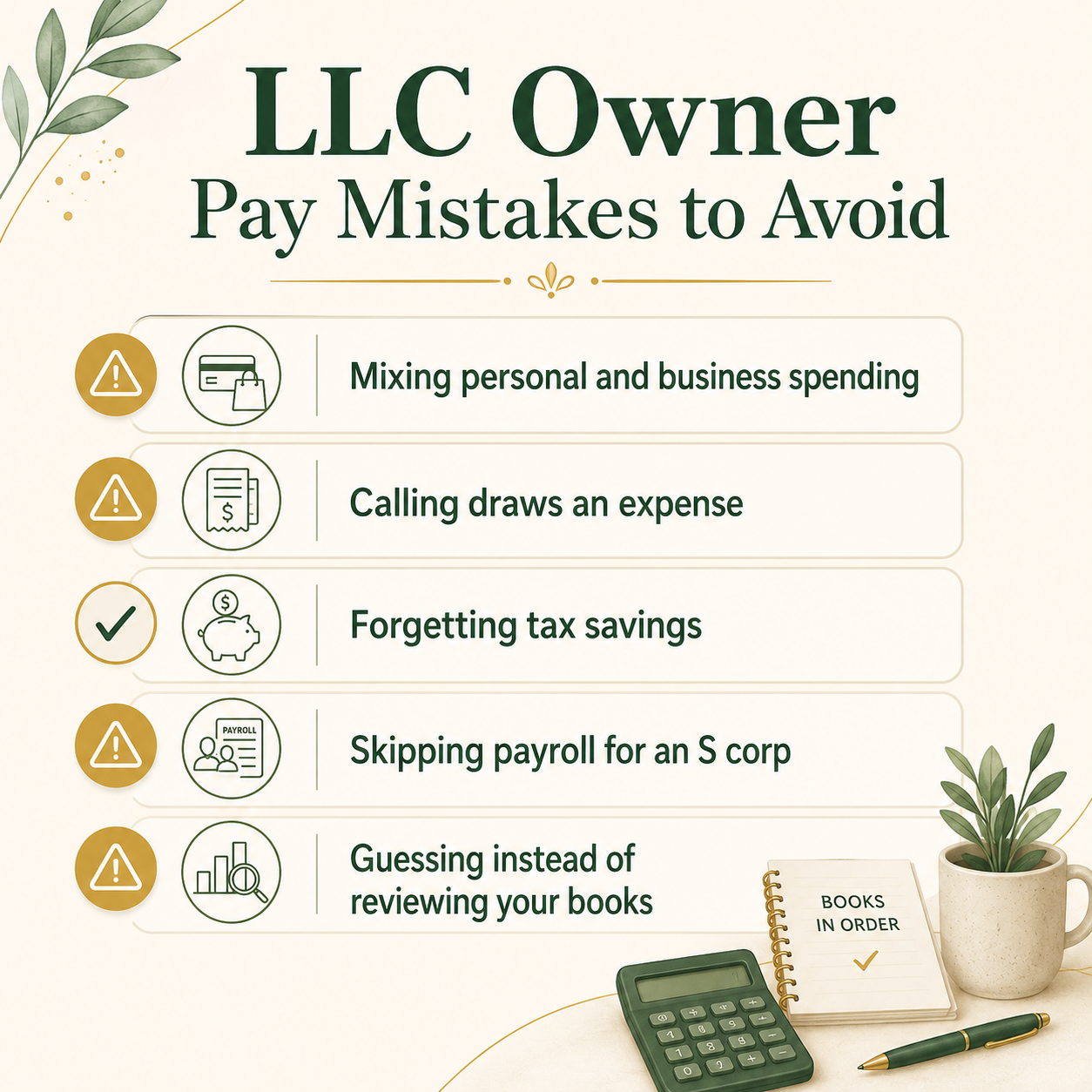
Common Mistakes When Paying Yourself as a Business Owner
Here are some common mistakes to avoid.
Mistake 1: Treating Owner Draws as Business Expenses
Owner draws are usually not business expenses.
If you categorize owner draws as expenses, your profit and loss report may be wrong.
Your business may look like it made less profit than it actually did.
That can create confusion at tax time.
Mistake 2: Forgetting About Taxes
Owner draws and distributions usually do not automatically withhold taxes.
If you take money out all year and do not save for taxes, tax time can be painful.
A separate tax savings account can help.
So can reviewing your profit regularly.
Mistake 3: Mixing Personal and Business Spending
Using the business account for personal purchases makes bookkeeping harder.
Even if you are the only owner, it is better to keep things clean.
Pay yourself intentionally.
Then use your personal account for personal spending.
Mistake 4: Running Payroll When You Should Be Taking Draws
Not every LLC owner belongs on payroll.
If you are a default single-member LLC, you usually take owner draws instead of paying yourself as an employee.
Running payroll when you do not need it can create extra cost, extra filings, and extra confusion.
Mistake 5: Taking Only Distributions From an S Corp
If your LLC is taxed as an S corporation and you work in the business, you usually need reasonable payroll compensation.
Taking only distributions can create problems.
Owner payroll and owner distributions should also be recorded separately in your books.
Is an S Corp Election How You Should Pay Yourself?
Maybe.
But not always.
S corp taxation can sometimes reduce self-employment tax. But it also adds more responsibility.
You may need:
- Payroll
- Payroll tax filings
- Reasonable salary planning
- More detailed bookkeeping
- A separate business tax return
- Additional tax preparation costs
An S corp election can be helpful for the right business at the right profit level.
But it is not automatically the best choice for every LLC.
Before making that election, talk with a tax professional who can review your actual numbers.
The goal is not just to save taxes.
The goal is to choose a structure that truly makes sense for your business.
So, What’s the Best Way to Pay Yourself From Your LLC?
Here is the simple version.
If your LLC is a default single-member LLC, you usually pay yourself with an owner’s draw.
If your LLC is taxed as a partnership, owner payments should follow the operating agreement. This may include draws or guaranteed payments.
If your LLC is taxed as an S corporation, you usually pay yourself through payroll as a W-2 employee. You may also take distributions when appropriate.
The best method is not just about getting money into your personal account.
It is about paying yourself in a way that:
- Matches your tax setup
- Keeps your books accurate
- Leaves enough money in the business
- Helps you plan for taxes
- Supports your cash flow
- Avoids surprises later
A good owner-pay system should help you feel clearer, not more confused.
Paying yourself from your LLC should feel simple.
But it should also be intentional.
A clean owner-pay system helps you understand what is really happening in your business.
It also makes your bookkeeping easier, your tax planning clearer, and your financial decisions less stressful.
If you are not sure whether your payments should be recorded as owner’s draws, payroll, or distributions, that is a good time to get help.
A little setup now can save a lot of cleanup later.
FAQs
What is an owner’s draw?
An owner’s draw is money you take out of your business for personal use. For many single-member LLC owners, this is a common way to pay yourself, but it is not the same thing as a payroll paycheck.
Can I pay myself a salary from my LLC?
It depends on how your LLC is taxed. If you are a single-member LLC tax as a sole proprietor, you usually take owner’s draws instead of payroll wages, but if your LLC is taxed as an S corp, you may need to pay yourself a reasonable salary through payroll.
Do I need to withhold taxes when I pay myself from my LLC?
If you are taking an owner’s draw, you usually do not withhold taxes from that payment like you would with an employee paycheck. Instead, you generally plan ahead for income tax and self-employment tax, often through estimated tax payments.
How often can I pay myself from my LLC?
You can usually pay yourself on a schedule that works for your business cash flow, such as weekly, twice a month, monthly, or after gibber client payments come in. The important thing is to leave enough money in the business for expenses, taxes, and slow seasons.
What’s the difference between an LLC draw and payroll?
An LLC draw is an owner taking money out of the business, while payroll is a formal paycheck with wages, tax withholding, and payroll tax filings. Which one you use depends largely on how your LLC is set up and taxed.
Do I need a separate bank account to pay myself?
Yes, it is a very good idea to have a separate business bank account. It keeps your business and personal money cleaner, makes bookkeeping easier, and helps you clearly track when money is being paid to you as the owner.
more2heather@gmail.com | (206) 227-6128