
You started a business, earned some money, and kept track of your expenses. Then you looked at the numbers and discovered something unsettling:
Your business expenses were higher than your business income.
Now what?
First, don’t panic. This does not automatically mean you did something wrong. New businesses commonly spend more than they earn while getting established. Even an existing business can have a loss during a slower year or after making a large investment.
However, a business loss can affect your tax return in several different ways. Let’s walk through what it may mean—and why accurate bookkeeping matters.


What Should You Do If Your Expenses Exceed Your Income?
If you are a sole proprietor or a single-member LLC taxed as a sole proprietorship, you will generally report your business income and expenses on Schedule C of your personal tax return.
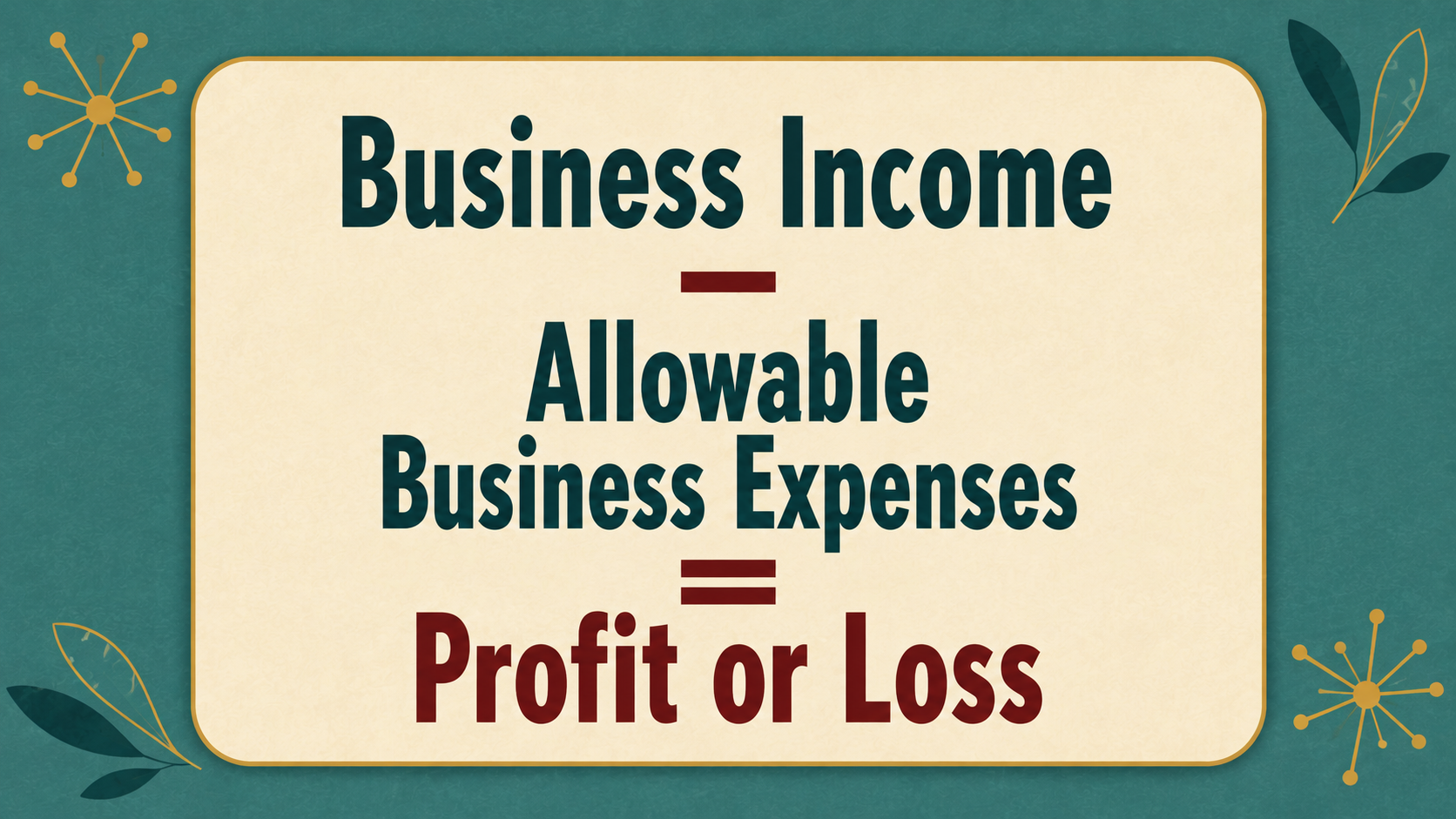
Your business profit or loss is calculated using a fairly simple formula:
Business income − allowable business expenses = net profit or loss
For example:
- Business income: $10,000
- Allowable business expenses: $13,000
- Business loss: $3,000
In this example, the business has a net loss of $3,000.
The loss is reported on Schedule C and then flows through to the owner’s personal tax return.
Can I Write Off Business Losses on My Personal Taxes?
Yes.
A legitimate business loss may reduce other income reported on your tax return. That could include:
- Wages from a W-2 job
- Your spouse’s wages if you file a joint return
- Income from another business
- Certain investment or retirement income
- Other taxable income reported on the return
Let’s say you operate a small business while also working a regular job:
- W-2 wages: $50,000
- Schedule C business loss: $3,000
The $3,000 business loss may help reduce the amount of income subject to federal income tax.
However, this does not necessarily mean you will receive $3,000 back from the government. A deduction reduces taxable income; it is not usually a dollar-for-dollar tax credit or reimbursement.
Exactly how much the loss affects your taxes depends on your complete tax return, including your other income, deductions, credits, filing status, and any loss limitations that apply.
What If I Don’t Have Other Income?
If you have little or no other income, you may not be able to use the entire business loss during the current year.
In some cases, a business loss may contribute to a net operating loss, commonly called an NOL. An NOL may be carried forward and used to reduce taxable income in a future year.
However, your Schedule C loss and your net operating loss are not automatically the same number.
An NOL is calculated using information from your entire tax return, with certain deductions added back or adjusted. This is one reason it is helpful to work with a qualified tax professional when your business reports a loss—especially if the loss is significant.
The IRS provides additional information about these calculations in its guidance on net operating losses.
When Do You Have To Pay Self-Employment Tax?
Self-employment tax is generally calculated on your net earnings from self-employment, not your total business income before expenses.
If your allowable business expenses are higher than your business income, you generally do not have positive net earnings from that business on which to calculate self-employment tax.
In our earlier example:
- Business income: $10,000
- Allowable expenses: $13,000
- Net business loss: $3,000
Because the business did not have a net profit, it would generally not generate self-employment tax for the year.
You may still owe federal income tax or other taxes because of income from another job, another business, investments, retirement distributions, or your spouse’s income.
A loss can also affect your future Social Security benefits because a year without net self-employment earnings may not add self-employment income to your Social Security earnings record.
Can All Business Expenses Be Tax Deductible?
Not necessarily.
For an expense to be deductible, it generally must be considered ordinary and necessary for your business. It should have a clear business purpose, and you need records showing what you purchased, how much you paid, and how it related to the business.
You also need to separate business expenses from personal expenses.
For example, you generally cannot deduct the entire cost of your phone, vehicle, internet service, or home utilities if you also use them personally. Only the allowable business portion may be deductible.
Some purchases are also handled differently for tax purposes. Equipment, furniture, vehicles, startup costs, inventory, and other large purchases may need to be depreciated, capitalized, or claimed under special rules rather than deducted as a regular expense all at once.
What Are Business Loss Limitations?
Certain deductions have limitations.
The home-office deduction is a common example. Under the regular home-office method, the deduction generally cannot exceed the income from the business after certain other expenses have been deducted. An unused amount may be carried forward, but it may not be allowed to create or increase the current business loss.
Other rules that may limit a loss include:
- At-risk limitations
- Passive-activity loss rules
- Business-interest limitations
- Partnership or S corporation basis limitations
- Excess-business-loss limitations
- Depreciation and vehicle deduction rules
Large business losses may require additional tax forms and calculations. The IRS explains that some noncorporate taxpayers must use Form 461 to determine whether the excess-business-loss limitation applies.
For a small Schedule C business with a modest loss, many of these rules may never come into play. Still, it is important to understand that “I spent the money” does not always mean “I can deduct all of it this year.”
Is It Okay for a Business to Lose Money?
Businesses do not have to make a profit every single year.
A loss may be understandable when:
- You recently started the business
- You purchased necessary equipment or supplies
- You invested in education, marketing, or a new website
- You experienced an unexpected interruption
- Sales were temporarily lower than expected
- You expanded the business
- You changed products, services, or locations
What matters is that you are genuinely operating the business with the intention of making a profit.
The IRS considers several factors when deciding whether an activity is a business or a hobby. These include whether you operate in a businesslike manner, maintain accurate records, devote time and effort to the activity, have the knowledge needed to make it successful, and make changes intended to improve profitability.
One loss year does not automatically turn your business into a hobby. Even several loss years do not necessarily settle the question by themselves. How many years can you claim a business loss? The IRS looks at all the relevant facts and circumstances. You can read more in the IRS guidance on distinguishing a business from a hobby.
A Tax Loss and a Cash-Flow Problem Are Not the Same Thing
This is an important distinction.
A business can show a loss on its tax return without being in immediate financial trouble. Depreciation, startup spending, or a planned investment may contribute to the tax loss.
On the other hand, a business can show a profit and still struggle to pay its bills. Loan principal payments, owner draws, inventory purchases, and the timing of customer payments can affect cash flow differently than they affect taxable profit.
That is why it is helpful to review more than your Profit and Loss statement.
You may also need to look at:
- Your Balance Sheet
- Bank and credit-card balances
- Accounts Receivable
- Outstanding debt
- Owner contributions and draws
- Monthly cash flow
- Which expenses are temporary and which will continue
Your tax return tells you one part of the story. Your bookkeeping helps you understand the rest.
Washington Business and Occupation Tax
Washington does not have a personal state income tax, but businesses may still be responsible for Business and Occupation tax, commonly called B&O tax.
B&O tax is generally based on gross business income, not net profit. Washington businesses usually cannot deduct regular operating expenses such as labor, materials, rent, or supplies when calculating B&O tax.
That means your business could report a loss for federal income-tax purposes and still have a Washington excise-tax filing requirement—or potentially owe B&O tax.
For example:
- Gross business income: $20,000
- Business expenses: $25,000
- Federal Schedule C loss: $5,000
The business may have a federal tax loss, but Washington generally looks at the $20,000 of gross income when determining B&O tax before applying any available credits or other adjustments.
You can learn more through the Washington Department of Revenue.
What Happens If My Business Shows a Loss?
Start by making sure your bookkeeping is complete and accurate.
Review your records for:
- Missing income
- Duplicate expenses
- Personal purchases recorded as business expenses
- Large purchases that may require special treatment
- Loan payments incorrectly recorded as expenses
- Owner contributions or draws recorded as income or expenses
- Vehicle, phone, internet, and home expenses that need to be divided between business and personal use
- Expenses placed in the wrong categories
Once the books are accurate, look at what caused the loss.
Was it a planned investment? A slow sales year? A one-time equipment purchase? Are you still building your customer base? Or are your regular expenses consistently higher than your income?
That answer matters—not only for your tax return, but also for the future of your business.
The Bottom Line
If your allowable business expenses are higher than your self-employment income, your business may report a net loss.
That loss may reduce other taxable income on your federal return. If it cannot all be used in the current year, some or all of it may carry forward, depending on your complete tax situation and the limitations that apply.
A loss does not automatically mean you made a mistake. It also does not mean every dollar will produce a tax benefit—or that Washington taxes disappear just because the business was not profitable.
Accurate bookkeeping gives you and your tax professional the information needed to determine:
- What caused the loss
- Whether the expenses were recorded correctly
- Which expenses may be deductible
- Whether any deductions or losses carry forward
- What the loss means for your business going forward
Most importantly, your records can help you see whether this was simply an investment year—or whether something needs to change.
Need Help Making Sense of Your Business Numbers?
If your Profit and Loss statement does not look the way you expected—or you are not sure whether your QuickBooks records accurately reflect what happened—I can help you review and organize the bookkeeping.
Together, we can look for missing transactions, incorrect categories, personal expenses, loan-payment issues, and other bookkeeping details that may be distorting your results. Clean, organized records make it easier for you to understand your business and give your tax professional reliable information to work with.
This article provides general educational information and is not individualized tax or legal advice. Tax rules can change, and the treatment of a business loss depends on your complete circumstances. Consult a qualified tax professional about your particular return.
FAQs
How long can a business show a loss?
There is no set number of years a business is allowed to report a loss. However, the IRS may look more closely at repeated losses to determine whether you are genuinely operating for profit. Earning a profit in at least three of five consecutive years generally helps support that you have a business rather than a hobby. IRS Publication 334
Can you only use excess business loss against business income?
An excess business loss generally cannot be used to offset additional nonbusiness income in the current year. The disallowed amount is usually carried forward as a net operating loss, or NOL, and may be deductible in a future year under the applicable NOL rules. IRS Publication 334
What are schedule c loss limitations?
A Schedule C loss may reduce other taxable income, but deductions can be limited by the at-risk rules, passive activity rules, excess business loss limits, and rules for activities not operated for profit. Some deductions, such as the home-office deduction, also have their own limitations.
What is a business occupation tax?
Washington’s Business and Occupation tax, usually called B&O tax, is a tax on a business’s gross income rather than its profit. That means most business expenses cannot be deducted before calculating the tax, although credits and small-business tax relief may apply. Washington Department of Revenue
How do you file B&O tax in Washington State?
Most Washington businesses report B&O tax on their excise tax return through the state’s My DOR system. Your filing frequency may be monthly, quarterly, or annually, and you generally must file a return even when you had no business activity. File through My DOR
How do I file quarterly business taxes in Washington State?
If the Washington Department of Revenue assigns your business a quarterly filing frequency, you will file your excise tax return through My DOR by the end of the month following each quarter. Federal estimated income and self-employment taxes are separate payments made to the IRS, usually using Form 1040-ES. Washington filing frequencies
How much is self-employment tax in Washington State?
- Washington does not have a separate state self-employment tax, but self-employed Washington residents may owe the federal self-employment tax. The federal rate is generally 15.3% of 92.35% of your net self-employment earnings, subject to annual Social Security limits and possible Additional Medicare Tax. IRS self-employment tax explanation
Can you file self-employment taxes without a business license?
Yes. Your responsibility to report self-employment income and pay federal taxes does not depend on whether you have obtained a business license. However, you may still be required to obtain state or local licenses, so filing taxes does not replace proper business registration.
How do you calculate 1099 taxes for self-employment?
- Start with your self-employment income, including income reported on Form 1099, and subtract your allowable business expenses to find your net profit. Self-employment tax is generally 15.3% of 92.35% of that profit., and you may also owe federal income tax based on your total income and tax bracket. IRS guide for self-employed businesses
Are consulting services taxable in Washington State?
Income from consulting services is generally subject to Washington B&O tax, often under the Service and Other Activities classification. Consulting is not automatically subject to retail sales tax, but certain services,( including some IT, website, software development, and advertising services) became taxable as retail sales on October 1, 2025, so the exact type of consulting matters. Washington services subject to sales tax
more2heather@gmail.com | (206) 227-6128